
Who Really Pays for US Wine Tariffs?

When the U.S. slapped a 25% tariff on European still wines in October 2019 — a side effect of the long-running Boeing-Airbus trade dispute — the debate quickly became: who pays? Farmers in Burgundy? Importers in New Jersey? Or the shopper reaching for a bottle on a Friday night?
A NBER working paper, published in October 2025, by economists at the Federal Reserve, University of Chicago, and Duke University offers the most complete answer yet. Using confidential transaction data from a major U.S. wine importer, the researchers tracked the exact same bottles from the European winery all the way to the retail shelf — and the findings carry lessons far beyond wine.
Consumers paid more than the tariff itself.
The short answer
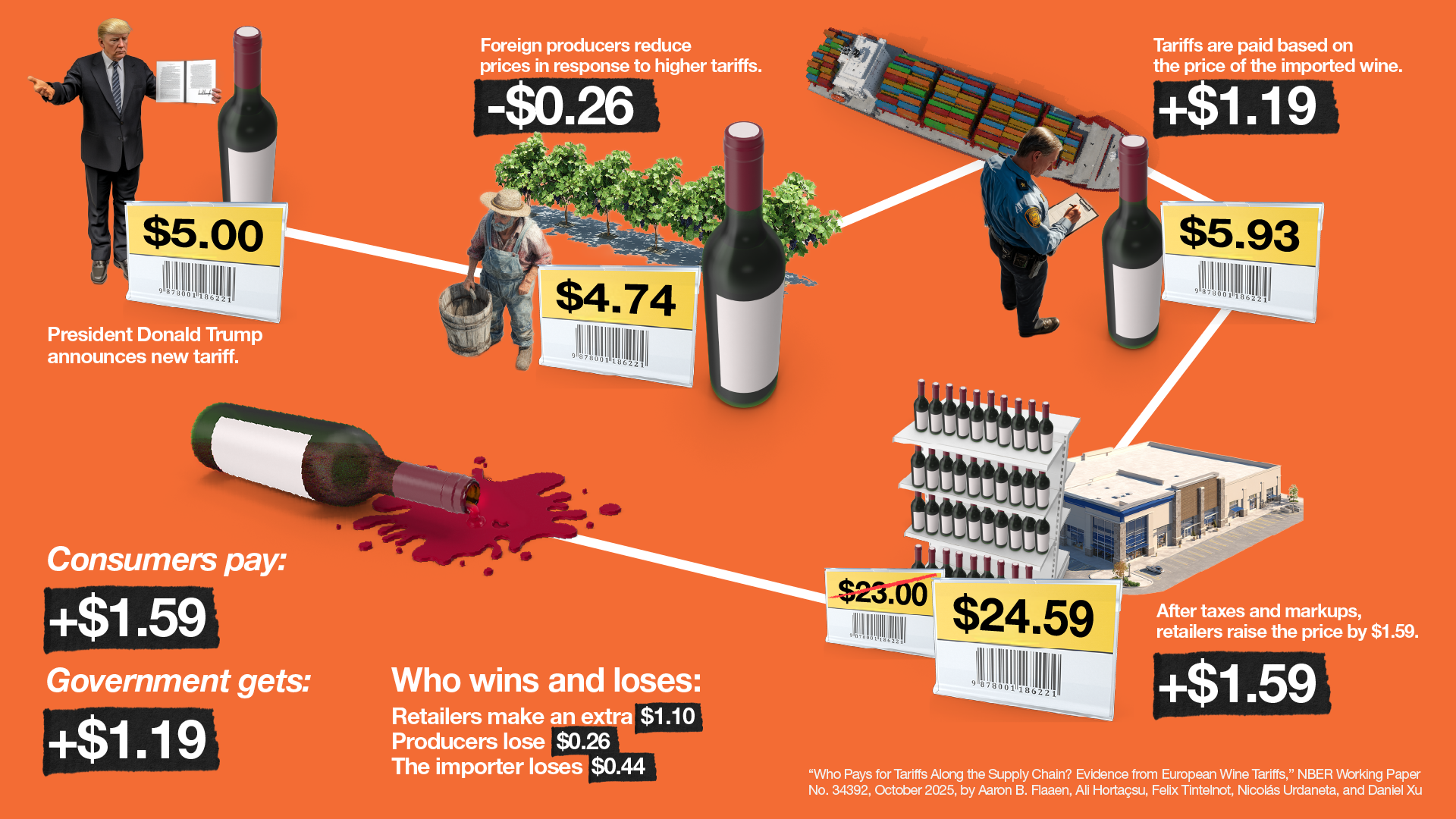
Here's how the math worked for a hypothetical $5 bottle at the border. Foreign producers absorbed part of the blow, cutting their prices by about 5.2%, saving around $0.26 per bottle. But that saving was swamped by what happened next. With the 25% tariff applied, the importer's costs surged by nearly 17%. The importer passed around 5.4% of that on to distributors — but their own per-bottle markup still shrank. The real amplification happened at the distributor-retailer stage. By the time the bottle hit the shelf, retail prices had risen by 6.9% — translating to $1.59 more per bottle, against tariff revenue of just $1.19 per bottle. In dollar terms, the pass-through to consumers exceeded 100%.
Why can small percentage increases add up to big dollar costs?
The answer lies in markups. A bottle that costs $5 at the European border sells for roughly $23 at retail — an 80% markup from importer to distributor, another 75% from distributor to retailer, and a further 50% at the shelf. Each stage applies its percentage markup to a rising base price. So even a modest percentage change at the border becomes a substantial dollar increase by the time it reaches the consumer. The authors note this mechanism isn't unique to wine: the average U.S. consumer goods markup between producer and purchaser is around 111%.
Timing matters too.
The tariffs hit in October 2019. Import prices started shifting within three months. But retail prices didn't fully respond until nearly a year later — a significant lag that has direct implications for how policymakers interpret inflation data from tariff episodes. Price spells at each stage explain much of this delay: the typical importer price holds for 14 months, distributor prices for 11 months, and retail prices for about 5 months.
And producers got creative.
Because the tariff only applied to wines with 14% alcohol by volume or less, producers and importers quickly found a workaround: relabeling wines as above 14% ABV. Label approval data shows the share of French wine approvals above the threshold jumped by nearly 40 percentage points immediately after tariffs took effect — and fell back just as quickly when tariffs were lifted in 2021. About a quarter of that shift appears to reflect existing wines being re-engineered rather than genuinely new higher-alcohol products. This kind of tariff engineering also distorts standard customs-based measurements of pass-through, making aggregate data appear to show full absorption by foreign producers when the reality was more nuanced.
The bigger picture for 2025 tariffs
The paper's authors are explicit that while wine is a narrow case study, the mechanisms it illustrates are general. With the U.S. pursuing broad tariff increases in 2025, the same dynamics — incomplete border pass-through, markup amplification through domestic supply chains, and long lags before consumer prices fully adjust — are likely at work across many goods categories. Policymakers and households alike should be cautious about interpreting low percentage pass-through at the border as evidence that consumers are being shielded from tariff costs.